Saint-Germain-des-Prés is one of the four administrative quarters of the 6th arrondissement of Paris, France, located around the church of the former Abbey of Saint-Germain-des-Prés.
WHAT YOU MAY SEE:
A pointed roof- un toit pointu
A parking lot- un parking
Some dogs- certains chiens
A tall tower-une grande tour
A hotel- un hôtel
WHAT YOU MAY HEAR:
some waiters serving food- certains serveurs servant des repas
The Latin Quarter of Paris is an area in the 5th and the 6th arrondissements of Paris. It is situated on the left bank of the Seine, around the Sorbonne.
WHAT YOU MAY SEE:
Lots of shops- beaucoup de magasins
Some red awnings- certains auvents rouges
Some crosswalks- certains passages pour piétons
Lots of street signs- beaucoup de signes de rue
Some balconies- certains balcons
WHAT YOU MAY HEAR:
lots of shopping bags crinkling- beaucoup de sacs froissement
The Catacombs of Paris are underground ossuaries in Paris, France which hold the remains of about six million people in a small part of the ancient Mines of Paris tunnel network.
WHAT YOU MAY SEE:
Some skulls- certains crânes
A lot of long hallways- un grand nombre de longs couloirs
Some tombstones- quelques pierres tombales
Lots of bones- beaucoup d'os
Some dirt- saleté
WHAT YOU MAY HEAR:
some ghosts- certains fantômes Filet Mignon
Place de la Concorde is situated at the end of the Champs-Elysées. Today it is famous for the Luxor Obelisk (a 3,300 year old Egyptian obelisk erected on the square in May 1998), the surrounding prestigious hotels, and the two monumental fountains (Fontaine des Mers and Fontaine des Fleuves). Created in 1772, Place de la Concorde was originally known for having been an execution site during the French Revolution. Louis XVI and Marie-Antoinette (among others) were guillotined here. Between 1836 and 1846 the architect Jacques-Ignace Hittorf redesigned the square to become what it is today.
WHAT YOU MAY SEE:
An obelisk- un obélisque
A bronze fountain- une fontaine de bronze
Some cars and buses- quelques voitures et bus
Some egyptian writing- une écriture egyptien
A large square- un grand carré
WHAT YOU MAY HEAR:
ambulances wailing- ambulances hurlantes
Disneyland Paris, originally Euro Disney Resort, is an entertainment resort in Marne-la-Vallée, a new town located 32 km east of the centre of Paris, and is the most visited theme park in all of France and Europe.
WHAT YOU MAY SEE:
A castle- Un château
Lots of kids- beaucoup d'enfants
Some characters- certains caractères
A colorful train- un train coloré
Some fireworks- un feu d'artifice
WHAT YOU MAY HEAR:
children screaming on rides: es enfants qui hurlent dans les manèges
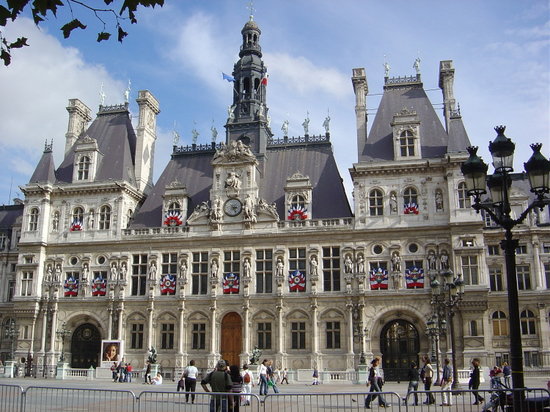
The Hôtel de Ville in Paris, France, is the building housing the city's local administration. Standing on the place de l'Hôtel-de-Ville in the 4th arrondissement, it has been the headquarters of the municipality of Paris since 1357. It serves multiple functions, housing the local administration, the Mayor of Paris (since 1977), and also serves as a venue for large receptions.
WHAT YOU MAY SEE:
An ice skating rink- une patinoire de glace
A wooden door- une porte en bois
A large wire ball- une grosse boule de fil
Lots of books- beaucoup de livres
Some lace curtains- des rideaux de dentelle
WHAT YOU MAY HEAR:
the wind blowing the lace curtains: la victoire souffler les rideaux de dentelle
The Pont Alexandre III is a deck arch bridge that spans the Seine in Paris. It connects the Champs-Élysées quarter with those of the Invalides and Eiffel Tower. The bridge is widely regarded as the most ornate, extravagant bridge in the city.
WHAT YOU MAY SEE:
Lots of lamp posts- beaucoup de lampadaires
A bridge- un pont
A view of the Eiffel Tower- une vue de la tour eiffel
Some tourist boats- certains bateaux touristiques
A plaque- une plaque
WHAT YOU MAY HEAR:
tourists laughing on a boat- touristes rire sur un bateau
Filled with fountains, ponds and sculptures, the formal, 28-hectare Tuileries Garden, which begins just west of the Jardin du Carrousel, was laid out in its present form in 1664 by André Le Nôtre, who also created the gardens at Vaux-le-Vicomte and Versailles. The Tuileries soon became the most fashionable spot in Paris for parading about in one’s finery. It now forms part of the Banks of the Seine Unesco World Heritage site.
WHAT YOU MAY SEE:
Some grass- un peu d'herbe
A ferris wheel- une grande roue
Lots of tulips- beaucoup de tulipes
different statues- différentes statues
Lots of tourists- beaucoup de touristes
WHAT YOU MAY HEAR:
the ferris wheel turning- la rotation de la grande roue
Les Invalides, commonly known as Hôtel national des Invalides (The National Residence of the Invalids), or also as Hôtel des Invalides, is a complex of buildings in the 7th arrondissement of Paris,France, containing museums and monuments, all relating to the military history of France, as well as a hospital and a retirement home for war veterans, the building's original purpose. The buildings house the Musée de l'Armée, the military museum of the Army of France, the Musée des Plans-Reliefs, and the Musée d'Histoire Contemporaine, as well as the Dôme des Invalides, a large church with the burial site for some of France's war heroes, most notably Napoleon Bonaparte
WHAT YOU MAY SEE:
The tomb of Napoleon- le tombeau de napoléon
A cannon- un canon
The french flag- le drapeau français
Some chimneys- quelques cheminées
A cobblestone path- un chemin pavé
WHAT YOU MAY HEAR:
some birds chirping- certains oiseaux gazouillent
The Palais Garnier in Paris is most commonly known as the Paris Opera, and is generally considered to be one of the most important buildings in Paris. It is centrally placed just a short distance from the Louvre. This 2,200 seat opera house was the successor to the Théâtre de l'Académie Royale de Musique, which had burned down in 1873. This landmark is a prime example of the Beaux-Arts architecture movement, in part drawing on the 17th century Classical Roman and Baroque style of emphasizing drama and grandeur as well as symmetry.
WHAT YOU MAY SEE:
A grand staircase- un grand escalier
Some red curtains- des rideaux rouges
Paintings on the ceiling- peintures du plafond
Rows of seats- des rangées de sièges
A lot of columns- un grand nombre de colonnes
WHAT YOU MAY HEAR:
people singing opera- les gens qui chantent l'opéra
The Palace of Versailles is the central part of a complex that housed the French government, most notably its royalty, during the reigns of Louis XIV (France’s famed “Sun King”), Louis XV and Louis XVI. After the French Revolution in 1789, it ceased to be a permanent royal residence. It is located about 10 miles (16 kilometers) southwest of Paris, it is beside the settlement of Versailles. Before the construction of the palace by Louis XIV, this settlement was little more than a hamlet but by the time of the revolution it had a population of more than 60,000 people, making it one of the largest urban centers in France.
WHAT YOU MAY SEE:
A black and white floor- un plancher en noir et blanc
Some gold gates- des portes d'or
Some bedrooms- certaines chambres
Marie Antoinettes bedroom - La chambre de marie antoinette
A statue of Poseidon- une statue de poseidon
WHAT YOU MAY HEAR:
people throwing coins in the pond- personnes jetant des pièces de monnaie dans l'étang
The home of France’s national collection from the impressionist, postimpressionist and art nouveau movements spanning the 1840s and 1914 is the glorious former Gare d’Orsay railway station – itself an art nouveau showpiece – where a roll-call of masters and their world-famous works are on display. Top of every visitor’s must-see list is the museum’s painting collections, centered on the world’s largest collection of impressionist and postimpressionist art.
WHAT YOU MAY SEE:
A clock- une horloge
Dome ceilings- plafonds dôme
A cafe- un café
A self portrait of Van Gogh- Un autoportrait de van gogh
Some art by Edward Degas- un peu d'art par Edward Degas
WHAT YOU MAY HEAR:
Shoes clacking on the floor- chaussures claquant sur le plancher
The Jardin du Luxembourg, located in the 6th arrondissement of Paris, was created beginning in 1612 by Marie de' Medici, the widow of King Henry IV of France, for a new residence she constructed, the Luxembourg Palace. The garden today is owned by the French Senate, which meets in the Palace. It is known for its lawns, tree-lined promenades, flowerbeds, the model sailboats on its circular basin, and for the picturesque Medici Fountain, built in 1620.
WHAT YOU MAY SEE:
Beautiful gardens- de beaux jardins
Some sailboats- quelques voiliers
Lots of chairs- beaucoup de chaises
A carousel- un carrousel
A playground- un terrain de jeu
WHAT YOU MAY HEAR:
Some bees buzzing- quelques abeilles bourdonnant
The Arc de Triomphe de l'Étoile is one of the most famous monuments in Paris. It stands in the centre of the Place Charles de Gaulle (originally named Place de l'Étoile), at the western end of the Champs-Élysées. It should not be confused with a smaller arch, the Arc de Triomphe du Carrousel, which stands west of the Louvre. The Arc de Triomphe honours those who fought and died for France in the French Revolutionary and the Napoleonic Wars, with the names of all French victories and generals inscribed on its inner and outer surfaces. Beneath its vault lies the Tomb of the Unknown Soldier from World War I.
WHAT YOU MAY SEE:
The tomb of the unknown soldier- la tombe du soldat inconnu
The eternal flame- la flamme éternelle
An arc- un arc
The champes Elysee- les champs elysées
Lots of cars- beaucoup de voitures
WHAT YOU MAY HEAR:
Lots of honking cars- beaucoup de voitures qui klaxonnent
Sainte-Chapelle is a royal chapel in the Gothic style, within the medieval Palais de la Cité, the residence of the Kings of France until the 14th century, on the Île de la Cité in the heart of Paris, France. Begun some time after 1238 and consecrated on 26 April 1248, the Sainte-Chapelle is considered among the highest achievements of the Rayonnant period of Gothic architecture. It was commissioned by King Louis IX of France to house his collection of Passion relics, including Christ's Crown of Thorns—one of the most important relics in medieval Christendom.
WHAT YOU MAY SEE:
Some chandeliers-quelques lustres
A lot of tall windows- un grand nombre de hautes fenêtres
A patterned ceiling- un plafond à motifs
An altar- un autel
A courtyard- une cour
WHAT YOU MAY HEAR:
People praying- gens qui prient
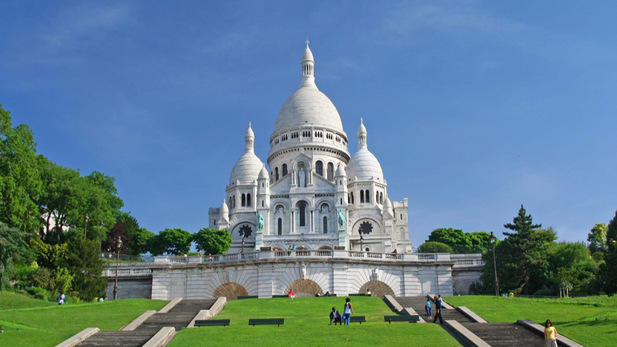
The Basilica of the Sacred Heart of Paris, commonly known as Sacré-Cœur Basilica and often simply Sacré-Cœur, is a Roman Catholic church and minor basilica, dedicated to the Sacred Heart of Jesus, in Paris, France. A popular landmark, the basilica is located at the summit of the butte Montmartre,
the highest point in the city. Sacré-Cœur is a double monument,
political and cultural, both a national penance for the defeat of France
in the 1871 Franco-Prussian War and the socialist Paris Commune of 1871 crowning its most rebellious neighborhood, and an embodiment of conservative moral order, publicly dedicated to the Sacred Heart of Jesus, which was an increasingly popular vision of a loving and sympathetic Christ.
WHAT YOU MAY SEE:
A lot of pews- un grand nombre de bancs
An incredible view- une vue incroyable
A latin phrase- une phrase latine
Two horse statues- deux statues de chevaux
Some flower shaped windows- certaines fenêtres en forme de fleur
WHAT YOU MAY HEAR:
people taking pictures- les gens de prendre des photos
Notre-Dame de Paris ; French for "Our Lady of Paris"), also known as Notre-Dame Cathedral or simply Notre-Dame, is a medieval Catholiccathedral on the eastern half of the Île de la Cité in the fourth arrondissement of Paris, France.The cathedral is widely considered to be one of the finest examples of FrenchGothic architecture, and it is among the largest and most well-known church buildings in the world. The naturalism of its sculptures and stained glass are in contrast with earlier Romanesque architecture.
WHAT YOU MAY SEE:
A cross- à travers
A bell tower- un clocher
A lot of stained glass- beaucoup de vitraux
Some candles- quelques bougies
The Seine river- la seine